
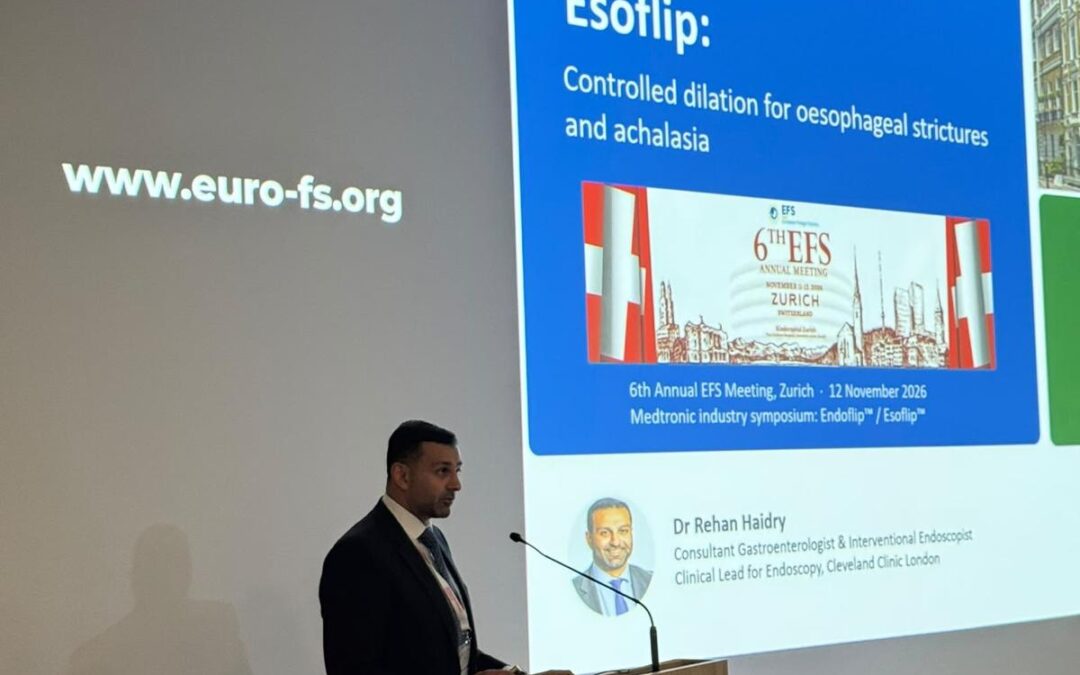
Annual meeting of the European Foregut Society in Zurich
At the annual meeting of the European Foregut Society in Zurich, Dr Rehan Haidry delivered a presentation entitled “Folding for Function: Technical Secrets of Transoral Incisionless Fundoplication (TIF)“, highlighting advances in minimally invasive treatment options for patients with gastro-oesophageal reflux disease (GORD).
GORD occurs when stomach contents, including acid and food, repeatedly flow back into the oesophagus, causing symptoms such as heartburn, regurgitation and chest discomfort. Left untreated, chronic reflux can damage the oesophageal lining and may lead to complications like Barrett’s oesophagus and even cancer of the oesophagus.
Many patients with reflux also have a hiatus hernia, where part of the stomach slides upwards through the diaphragm. This can weaken the body’s natural anti-reflux mechanism and contribute to ongoing symptoms. Depending on the size of the hernia, different treatment approaches may be required.
During his presentation, Dr Haidry discussed transoral incisionless fundoplication (TIF), an advanced endoscopic procedure performed entirely through the mouth without abdominal incisions. The treatment reconstructs the anti-reflux valve between the oesophagus and stomach, helping to prevent reflux while preserving the ability to belch and vomit. Studies have shown that many appropriately selected patients can achieve long-term symptom improvement and reduce or stop their reliance on daily reflux medication.
He also highlighted the distinction between TIF and cTIF (concomitant hiatal hernia repair and transoral incisionless fundoplication). TIF is generally suitable for patients with reflux and either no hiatus hernia or a small hernia of up to 2cm. For patients with larger hiatus hernias, cTIF combines laparoscopic hiatal hernia repair with TIF during the same anaesthetic. The hernia is first returned to its normal position below the diaphragm before an anti-reflux valve is created endoscopically.
Unlike traditional anti-reflux surgery, which typically creates a complete 360-degree wrap around the lower oesophagus, TIF creates a less restrictive 270-degree valve. This approach aims to provide durable reflux control while reducing side effects such as bloating, difficulty belching and swallowing problems.
Dr Haidry leads EURO-TIF, the European registry evaluating outcomes from TIF and cTIF procedures across leading centres in Europe. Cleveland Clinic London serves as a European training centre for the technique and coordinates the registry’s data collection programme, helping to strengthen the evidence base for minimally invasive reflux treatments.
His presentation reflected growing interest in procedures that bridge the gap between lifelong medication and conventional surgery, offering selected patients an effective, less invasive route to long-term reflux control.